The moments after a severe Maryland storm are often chaotic. High winds, heavy rain and lightning can leave even a healthy landscape looking like a disaster zone. When you step outside and see limbs scattered across your lawn or a large trunk leaning precariously, your first instinct might be to grab a chainsaw and start clearing. Knowing what to do after a storm damages your trees is vital for your safety and for the long-term survival of your landscape.
At Genesis Tree Care, we've seen how improper post-storm cleanup can lead to more property damage or serious accidents. This guide outlines the essential steps to secure your property and begin recovery.
1. Safety First: Look Up
Before you go near a damaged tree, do a full safety sweep. The most dangerous threats are often hanging directly over your head.
- Check for power lines: If a tree or branch has fallen on a power line, or lines are sagging nearby, do not approach. Electricity can travel through the ground and the tree itself. Call your utility company immediately.
- Identify hangers: Look for broken limbs still caught in the upper canopy. They can fall at any moment.
- Stay clear of leaning trees: If a tree is leaning where it wasn't before, its root system is compromised, and it can finish falling without warning.
If the situation looks unstable, keep family and pets indoors and call for emergency tree service to secure the site.
2. Assess the Level of Damage
Once the immediate danger has passed, decide whether the tree can be saved or needs removal. A little triage helps.
Minor damage
If the tree has only lost small branches and most of its structure is intact, it will likely recover. Clean pruning cuts help the tree seal its wounds and resist decay.
Major damage
- Crown loss: As a rule of thumb, if more than half of a tree's crown (the leafy part) is gone, the tree will struggle to survive.
- Trunk splitting: If the main trunk is split or the leader (the top vertical stem) is snapped, the tree's structure is usually compromised for good.
- Uprooting: Heaving soil or exposed roots mean the tree is likely a loss and a significant hazard.
3. Avoid Do-It-Yourself Disasters
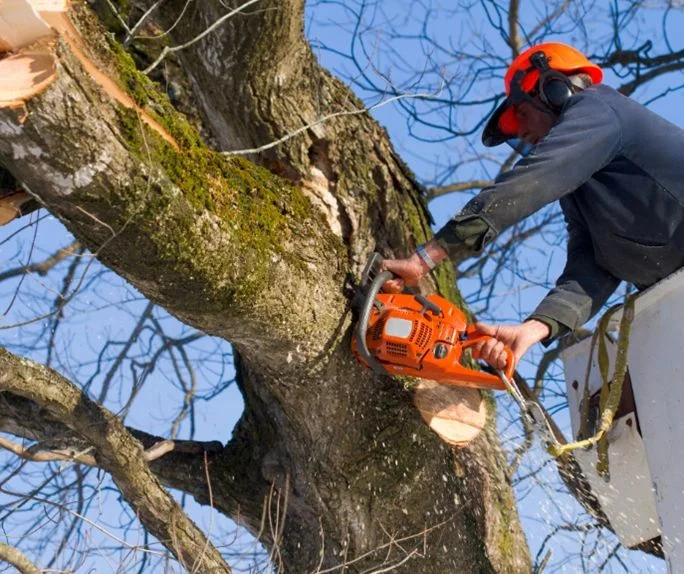
After a storm, the neighborhood fills with the sound of chainsaws. It's tempting to handle cleanup yourself, but storm-damaged wood is extremely unpredictable.
Branches can be under enormous tension or compression. Cut a limb pinned under the weight of another, and it can spring back violently. Our crews are trained in storm cleanup and use rigging to release that tension safely.
4. Prune for Healing, Not Just Clearing
If the tree can be saved, how it's pruned in the following days matters.
Avoid topping, cutting all the top branches back to a uniform height. It creates enormous stress and leads to weak, upright sprouts that break in the next storm. Instead, use proper pruning cuts at the branch collar, which let the tree's natural defenses seal off the wound and keep out decay fungi.
5. Consult a Certified Arborist
Sometimes the damage isn't obvious. A tree might look fine after a storm but have internal cracks or a weakened root system that won't show symptoms for months.
A post-storm check from a certified arborist can prevent a failure during the next weather event. We can recommend deep-root fertilization to help a stressed tree recover, or cabling and bracing to support a weakened structure.
FAQ: Post-Storm Tree Recovery
Who is responsible if my tree falls in my neighbor's yard?
Generally, if a healthy tree falls during a major storm, the owner of the property where it lands handles cleanup through their own insurance. If the tree was a known hazard before the storm, though, you could be liable. Check with your insurer for your specific situation.
Should I fertilize my trees immediately after a storm?
Not necessarily. The tree needs to focus on sealing its wounds first. A slow-release fertilizer or soil conditioner applied a few weeks later can help supply nutrients for the next growing season.
My tree lost all its leaves in a hailstorm. Will it die?
Probably not. Most healthy trees have enough stored energy to produce a second flush of leaves. As long as the branches and trunk aren't severely damaged, the tree should recover by the following spring.
Conclusion
The sight of a mangled tree can be heartbreaking, especially if it anchored your landscape. By staying calm and knowing what to do after a storm damages your trees, you can prevent further injury and make the best decision for your property.
Genesis Tree Care helps our neighbors through the aftermath of Maryland's toughest weather. Whether you need a tree removal or a professional health assessment, our team is ready to restore safety to your yard.
Don't risk it after a storm: contact Genesis Tree Care for professional storm damage recovery.